- Retired, Dec. 2023
- Gradually pruning content of this web page
- resume.
- Not recruiting any student!
- Working on my magnum opus: The Four Books of Structural Analysis, and another Finite Element Analysis of Concrete Dams (with Hariri and Mahdavi).
- This is a link to some of my Alkali-Aggregate Reactions related publications (more coming).
Big Picture of my research (Click on node to expand / shrink)
Publicly available lecture notes
- Retired.
- Working on my magnus opus The Four Books of Structural Analysis, and another on Finite Element Analysis of Concrete dams (with Harir and Mahdavi).
- This is a link to some of my Alkali-Aggregate Reactions related publications (more coming).
Immediate Past
- Dec. 31, 2023 My last day at the University of Colorado. Retiring after 40 years!
- Dec. 21, 2023: my last PhD student, Ms. Golsa Mahdavi Graduates
- Dec. 8, 2023; Gave my last seminar at the University of Colorado. This file succinctly summarize my experience with various agencies.
- Completed a three years project funded by the Bureau of Reclamation (Long Term Assessment of Dams Suffering from Alkali Aggregate Reaction). We are performing a very detailed finite element analysis of one of their dam suffering from AAR dam.
- Installed a search engine for a literature survey of AAR in dams.
- Gave a two hours presentation to USSD “How to tackle Dams with AAR” (Feb. 2022).
- Assisted New Brunswick Hydro (through GEMTEC) to analyze laboratory expansion data on specimens collected from
Mactaquac dam (2021). - Made a presentation to the Public Meeting on Development of Guidance Documents to Support License Renewal for 100 Years of Plant Operation (Jan 2021)
- Graduated Mr. Yuichiro Gakuhari (M.S.). His thesis addressed (among others) a0 RANSAC method to eliminate outliers when analyzing field data; 2) Comparison of “State of the Practice” and “State of the Art” analysis methods for dams sufferings from AAR.. 3) Performed sensitivity analysis (Morris method) for AAR properties; and 4) Uncertainty quantification.
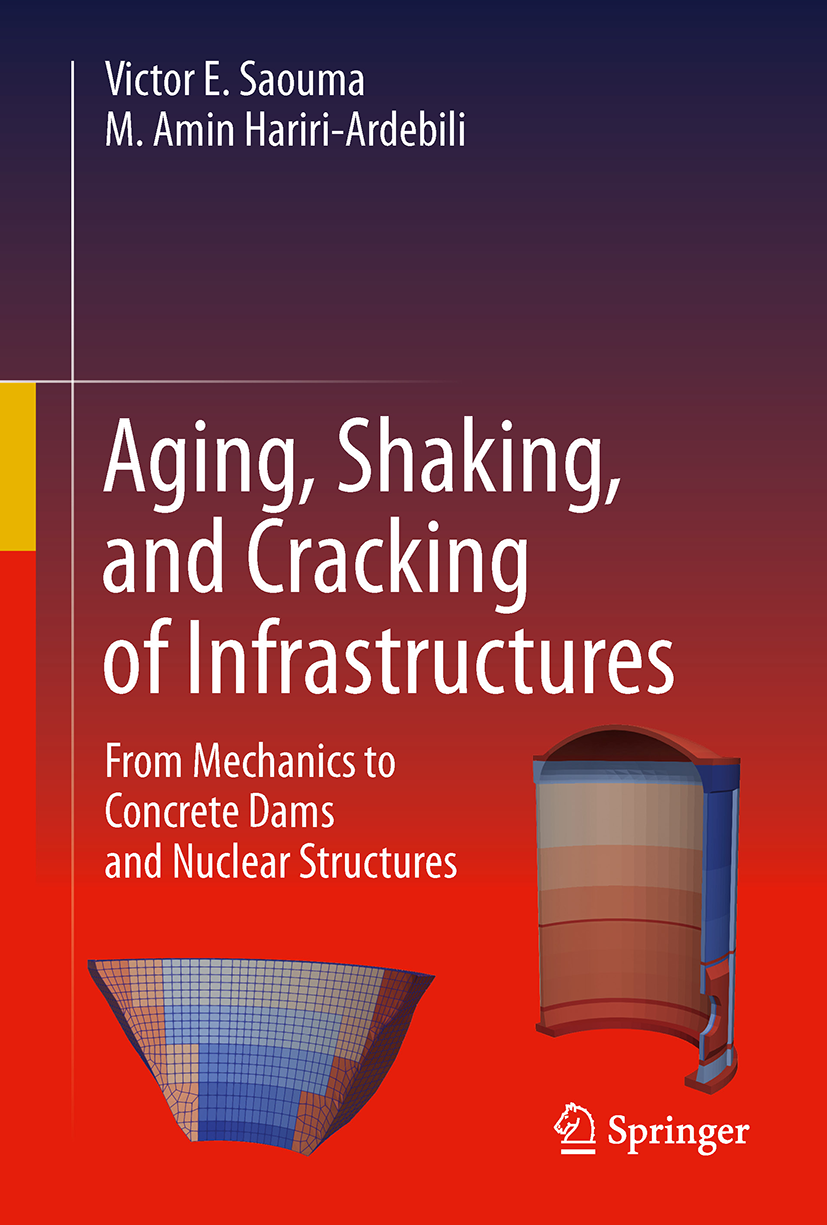
- Published Ageing, Shaking and Cracking of Infrastructures; Concrete Dams and Nuclear Structures by Springer-Nature.
- Review of Hanbit Nuclear Power Plant, Unit 4 Documents; Consulting work.
- Nice proclamation from the City of Newburyport
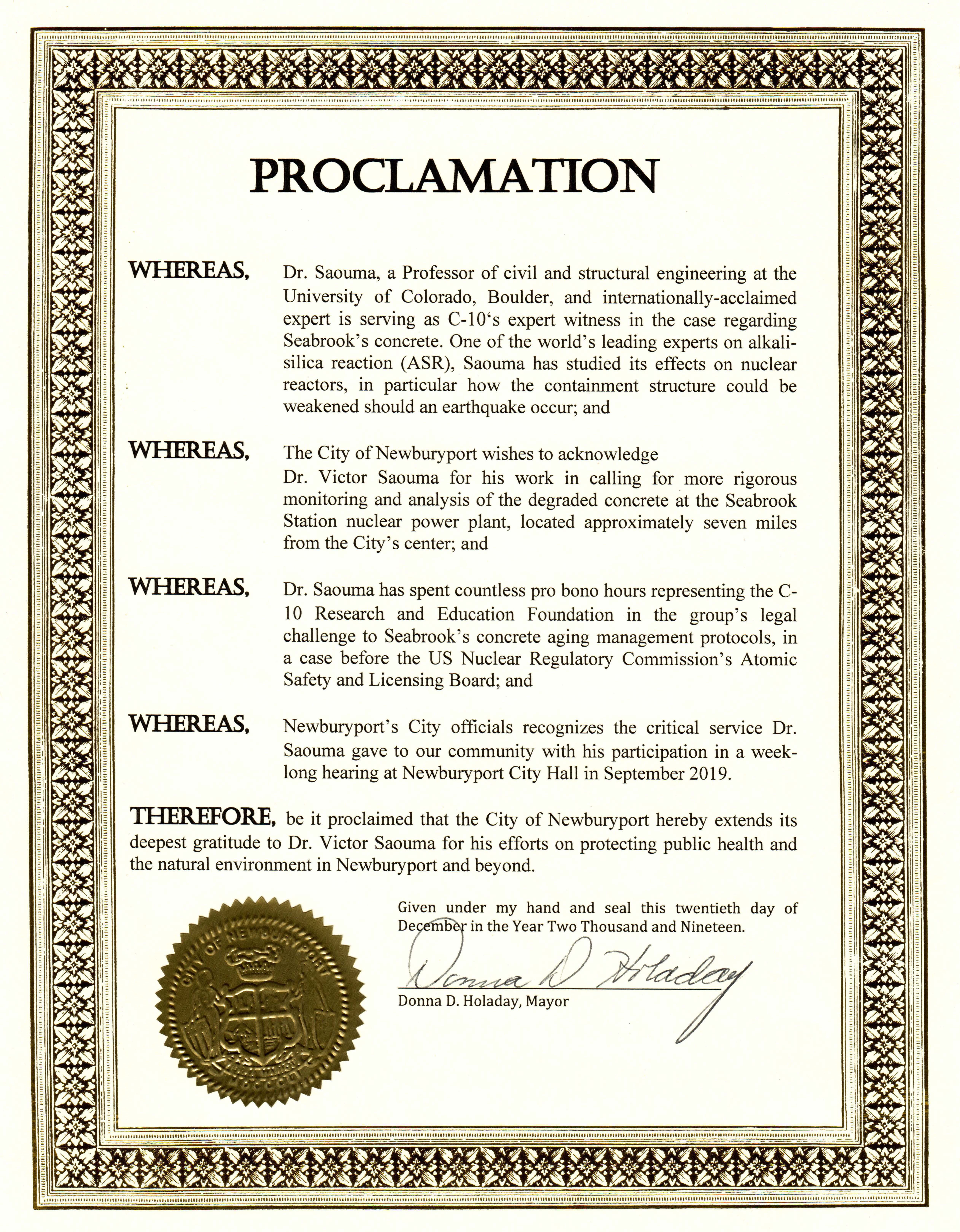
- Expert witness for C-10‘s legal challenge to Seabrook’s concrete testing and monitoring.
- Completed three years assignment in the Dept. Executive Committee (discovered the celebrities and authorities among my colleagues)
- Chair of the RILEM committee on Prognosis of deterioration and loss of serviceability in structures affected by alkali-silica reactions.
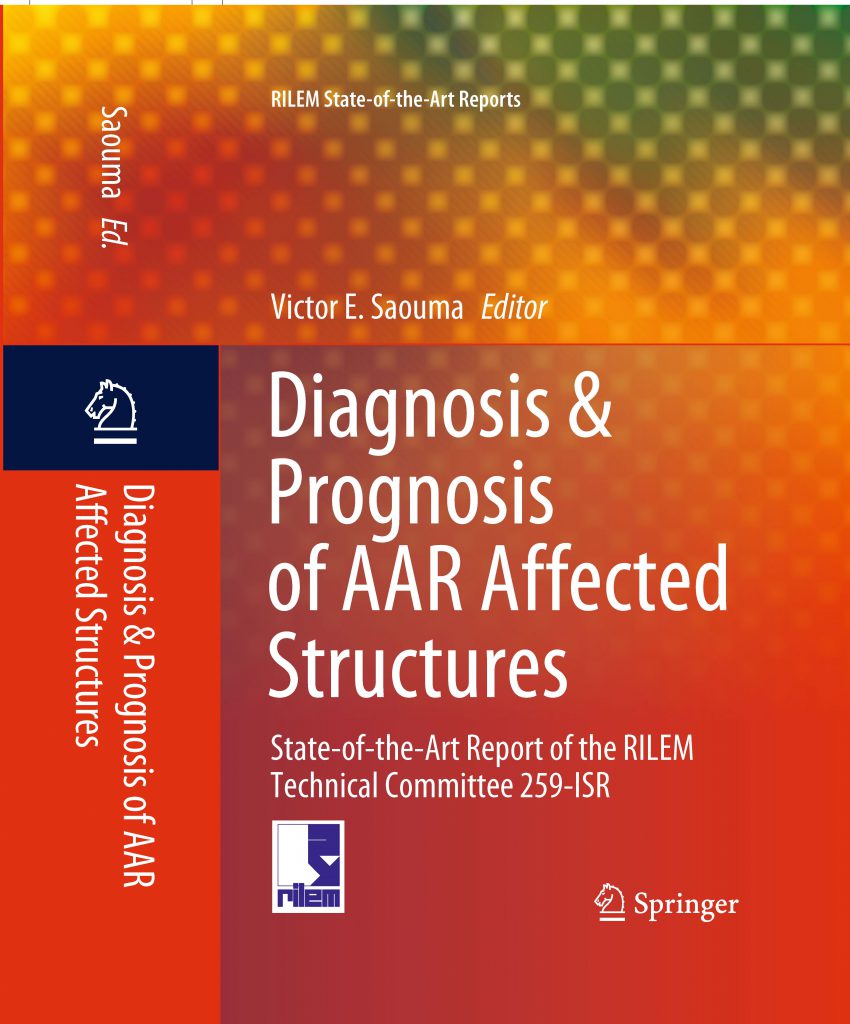
- Published (as Editor) State of the Art Report (STAR) for the RILEM committee on Prognosis of deterioration and loss of serviceability in structures affected by alkali-silica reactions published with Springer-Nature.
- Experimental and Numerical Investigation of the impact of Alkali-Silica Reaction on nuclear containment vessel structures. Grant No. NRC-HQ-60-14-G-0010 from the Nuclear Regulatory Commission (Laboratory tests to assess shear degradation in concrete due to ASR, prognosis for future expansion, and 3D seismic simulation of a nuclear containment vessel subjected to prior ASR strength reduction). Public Report
- 2016 Independent Modeling of the Alkali-Silica Reaction Mock-Up Test Block Grant from the Oak Ridge National Laboratory.
- Past (2013-2016) President of the International Association of Fracture Mechanics for Concrete and Concrete Structures IA-FraMCoS
- M.S. thesis of David Graff Environmental and Reinforcement Effects on Concrete Expansion Undergoing Accelerated Alkali Silica Reaction, 2017
- M.S. thesis of Rob Sparks The Alkali-Silica Reaction: A Study of Reactive Aggregates and Production of Expansive Concrete Specimens, 2016
- Member of the Scientific Committee of OECD/NEA/CSNI CAPS ASCET – Assessment of Structures subject to Concrete Pathologies.
- Member of the Scientific Committee of MACENA, Managing confinement structures in the event of an accident, France.
- Past Member of the Expanded Proactive Materials Degradation Analysis Expert Panel (PMDA) for concrete in nuclear reactors Nuclear Regulatory Commission, 2010-2014.
- Alkali-Silica Reaction in Nuclear Power Plants (2014-2015) funded by the Oak Ridge National Laboratory (Numerical simulation of structural components subjected to ASR and accompanying strength degradation; Development of a coupled heat-moisture code for NPP).
- M.S. thesis of Rob Sparks The Alkali-Silica Reaction: A Study of Reactive Aggregates and Production of Expansive Concrete Specimens, 2016
- Member of the Scientific Committee of OECD/NEA/CSNI CAPS ASCET – Assessment of Structures subject to Concrete Pathologies.
- Member of the Scientific Committee of MACENA, Managing confinement structures in the event of an accident, France.
- Past Member of the Expanded Proactive Materials Degradation Analysis Expert Panel (PMDA) for concrete in nuclear reactors Nuclear Regulatory Commission, 2010-2014.
- Alkali-Silica Reaction in Nuclear Power Plants (2014-2015) funded by the Oak Ridge National Laboratory (Numerical simulation of structural components subjected to ASR and accompanying strength degradation
- Review of Hanbit Nuclear Power Plant, Unit 4 Documents; Consulting work.
- Expert witness for C-10‘s legal challenge to Seabrook’s concrete testing and monitoring.
- Completed three years assignment in the Dept. Executive Committee (discovered the celebrities and authorities among my colleagues)
- Chair of the RILEM committee on Prognosis of deterioration and loss of serviceability in structures affected by alkali-silica reactions.
- Published (as Editor) State of the Art Report (STAR) for the RILEM committee on Prognosis of deterioration and loss of serviceability in structures affected by alkali-silica reactions published with Springer-Nature.
- Experimental and Numerical Investigation of the impact of Alkali-Silica Reaction on nuclear containment vessel structures. Grant No. NRC-HQ-60-14-G-0010 from the Nuclear Regulatory Commission (Laboratory tests to assess shear degradation in concrete due to ASR, prognosis for future expansion, and 3D seismic simulation of a nuclear containment vessel subjected to prior ASR strength reduction). Public Report
- 2016 Independent Modeling of the Alkali-Silica Reaction Mock-Up Test Block Grant from the Oak Ridge National Laboratory.
- Past (2013-2016) President of the International Association of Fracture Mechanics for Concrete and Concrete Structures IA-FraMCoS
- M.S. thesis of David Graff Environmental and Reinforcement Effects on Concrete Expansion Undergoing Accelerated Alkali Silica Reaction, 2017
- M.S. thesis of Rob Sparks The Alkali-Silica Reaction: A Study of Reactive Aggregates and Production of Expansive Concrete Specimens, 2016
- Member of the Scientific Committee of OECD/NEA/CSNI CAPS ASCET – Assessment of Structures subject to Concrete Pathologies.
- Member of the Scientific Committee of MACENA, Managing confinement structures in the event of an accident, France.
- Past Member of the Expanded Proactive Materials Degradation Analysis Expert Panel (PMDA) for concrete in nuclear reactors Nuclear Regulatory Commission, 2010-2014.
- Alkali-Silica Reaction in Nuclear Power Plants (2014-2015) funded by the Oak Ridge National Laboratory (Numerical simulation of structural components subjected to ASR and accompanying strength degradation; Development of a coupled heat-moisture code for NPP).
- Made a presentation to the Public Meeting on Development of Guidance Documents to Support License Renewal for 100 Years of Plant Operation (Jan 2021)
Research Interests

I have resisted the pressure to remain focused on one or a few research interests during my academic career, and have always sought to pursue what I perceived to be particularly interesting at a given time (a delicate balance between opportunity and interest). This has at times hurt my career, but I had fun in “escaping the reality” of academia and have always tried to think outside the box.
- Earthquake Engineering
- Non linear transient analysis of concrete dams (accompanying English and Spanish presentation).
- Fast Hybrid Testing (If you are not familiar with the concept of hybrid simulation, or real time hybrid simulation, the following video (put together when we were a NEES centre) describes this novel testing paradigm, you should click on the play key bottom right).
- Dynamic 3 DOF Pushover Tests of a R/C Column.
- Nonlinear Real Hybrid Simulation of a 402 DOF R/C Frame.
- Intersection of earthquakes and cultures.
- Fracture mechanics
- Fracture of concrete, rocks, ceramics, and polymers.
- Fractal analysis
- Concrete and reinforced concrete deterioration
- Alkali-Aggregate Reactions.
- Chloride Diffusion
- Nonlinear finite element simulation of reinforced concrete structures, in particular
- Dams (gravity, arch) subjected to strong seismic excitation, or alkali-aggregate reactions.
- Nuclear reactor containers, in particular: ageing, cracking, structural assessment (Such as Crystal River delamination).
- Performance Based Earthquake Engineering of concrete Dams (PhD Thesis of Mr. Mohammad Hariri-Ardebili)
- Analytical analysis of arches and shells (MS Thesis of Ms. Trupti Sonavane and Mr. Ryan Georg) If video is not playing, please refresh this page.
Education
Cornell University, Ph.D. in Civil Engineering, September 1980 (A. Ingraffea Advisor).
Cornell University, M.E. in Civil Engineering, January 1977.
American University of Beirut, B.E. in Civil Engineering, June 1975.
Lycée Chateaubriand, Rome, Baccalaureat Francais, Série Scientifique, 1971
Teaching
As many Professors, I found most text-books inadequate, boring, and often superficial. As such I wrote over the years my own set of lecture notes:
1.Structural Analysis.
2. Structural Concepts and Systems for Architects.
3. Mechanics of Reinforced Concrete.
4. Computer Literacy for Undergraduates.
5. Intermediary Structural Analysis.
6. Nonlinear analysis of framed structures.
7. Fracture mechanics.
8. Advanced Mechanics of Materials.
9. Finite Element Analysis
Appointments
- Visiting Professor, (typically 1 summer month): Universite de Toulouse (2009), Politecnico of Catalunya, (2007, 2010); Ecole Normale Supérieure de Cachan, (1992, 1994, 2007);
- Visiting Professor, Politecnico of Milan, Department of Structural Engineering, 2003-2004.
- Visiting Professor, Swiss Federal Institute of Technology (Lausanne), Civil Engineering (January-June 1990); Material Science Department, 1997-1998.
- Professor (1995 to present), Associate Professor (1988-1995), Assistant Professor (1984-1988), Department of Civil, Environmental, and Architectural Engineering, University of Colorado, Boulder.
- Assistant Professor, Department of Civil Engineering, University of Pittsburgh, Pittsburgh, PA, Sept. 1981-Dec. 1983.
- Research Associate, Department of Civil Engineering, Princeton University, Princeton, N.J., Oct. 1980 – Aug. 1981.
Recent Thesis
- Design of an AAR Prone Concrete Mix for Large Scale Testing, M.S. thesis, 2016, Robb Sparks.
- Effect of AAR on Shear Strength of Panels, M.S. Thesis, 2017, David Graff.
- Performance Based Earthquake Engineering of Concrete Dams, Mohammad Amin Hariri-Ardebili, Doctoral Thesis (2015) (Hopefully, a landmark work on probabilistic safety assessment of dam) Thesis.pdf will be made available after publication of the many papers it generated.
- Automated Non-Linear Pushover Analyses of Reinforced Concrete Structures, Kyle Prusinski Master Report, 2015 (Theory and Matlab based implementation of the pushover analysis of reinforced concrete frames)
- Analysis of Arches, Trupti Sonavane, Master Thesis, 2014 (Analytical solution (with Mathematica) of statically indeterminate arches)
- Historical Analysis of Arches and Modern Shells, Ryan Georg, Master Thesis, 2014 (History of analysis of arches and analytical analysis of shells with design example in Matlab)
Publications
A full list of my publications is easily found in my my resume
Research
- Cracking of a Nuclear Reactor Container I have lately been heavily involved in the root cause investigation of the craking on a nuclear reactor container. This involved both 3D nonlinear finite element analysis, as well as performing various tests on concrete cores recovered from the site.
- Non linear transient analysis of concrete dams: From 2000-2009 my research has been funded by the Tokyo Electric Power Service Company (TEPSCO). Within the framework of this project, we seek to develop a State of the Art finite element program (Merlin) for the 3D nonlinear, transient, multiple-CPU, analysis of concrete dams. Centrifuge tests for validations were also performed both in Boulder and Tokyo. OpenGL based pre and post processors are also being developed. (Kumo and Spider). Prior to this project, I was funded for 5 years by the Electric Power Research Institute (EPRI) to examine the applicability of fracture mechanics to concrete dams.
- Fast Hybrid Testing: From 2005-2009 I directed and managed the CU-NEES site. Following the closure of the site, I supervised the development of development of Mercury, a software to facilitate single site, hybrid simulation through serial or parallel computers, and taking advantage of innovative hardware such as FPGPA)
- Currently testing a reinforced concrete frame previously tested on a shake table. Another component is to explore the applicability of FHT to aerospace vehicle testing.
- Fracture of concrete: Over the years, I have conducted numerous innovative and large scale tests to examine the fracture properties of concrete. These include: large wedge splitting tests (1.5×1.5 m and 7.5 cm MSA); Static and Dynamic fracture properties; Static and dynamic fluid pressure inside cracks; Fatigue crack propagation; Fracture of joints subjected to both static and cyclic loads. In practically all cases tests were first performed, a theoretical model was then developed, and finally a finite element code (MERLIN) was then modified to implement the model and test it.
- Fracture of Solid Rocket Propellants Through a collaboration with a German company, we have tested the fracture energy of solid rocket propellant, then modeled the cracking of the propellant in a rocket, and are currently developing a code which couples combustion simulation with fracture mechanics.
- Fracture of rocks: Tested soft rock (Tuffo), and planning to apply those test results to the analysis of cave stability in Naples (with Prof. Viggiani/Grenoble).
- Fracture of Ceramics: (with Prof. Sbaizero) performed numerical simulations of ceramic fractures by applying concrete nonlinear models.
- Fractal analysis: Performed some early tests to determine the fractal dimension of cracked concrete, extended the size effect law to account for fractal cracks.
- Alkali-Aggregate Reactions: Developed a constitutive model for concrete undergoing AAR. Implemented the model in MERLIN and then performed 3D analyses of both dams and massive reinforced concrete strucutres. Designed, built and tested a triaxial frame to subject a concrete cube undergoing an AAR to a constant pressure, temperature and humidity, and then measure expansion in the three directions.
- Chloride Diffusion: Developed a fully coupled nonlinear model (finite difference) for the coupled diffusion of chloride and carbonation in concrete. Applied this model to subsequently determine the extent of corrosion and cracking in the concrete.
- Nonlinear finite element simulation of reinforced concrete: This is an extension of my work in dams. Having the appropriate computational tools (MERLIN), I have performed the nonlinear analysis of a portion of a nuclear reactor containment vessel, and performed a number of simulations (with Prof. Al-Mahaidi and Spacone) for the fracturing of FRP.
Computer Programs
Developed, supervised development of the following computer programs:
- Finite Element Analysis MERLIN, User’s manual, and Theory manual.
- Optimized Computational Environment for Real Time Hybrid Simulation Mercury Finite Element Mesh Generator KumoNoSu.
- Finite Element post-processor, Spider. Modeling of concrete deterioration, CDAP.
- Simulation of silica aggregate reaction (at the macro-level), SIMSAR.
- Generation of Finite Element mesh for heterogeneous material, PARSIFAL.
Personal Info
You can find my personal information here